


Malawi's expensive mobile phone habit. HIGHEST in the World! Highest in Africa.

One of the first things to strike a visitor to Malawi is the huge number of advertisements put up by mobile phone companies marketing their products.
"Muli bwanji? (How are you?)" reads one of the huge red billboards in the local language Chichewa.
Another colourful one shows the picture of a jet plane taking off, announcing cheaper call tariffs.
Everywhere you look across major towns in Malawi, you will see the attempt to entice consumers - from branding on umbrellas used by street vendors to T-shirts and even vans.
But mobile services are anything but low-priced in this country.
In fact, a report by the International Telecommunications Union (ITU) says on average Malawians use more than $12 (£7.70) a month on mobile phones.
This is more than half of what an ordinary Malawian earns in a month.
Cheapest:
Macau, China - 0.11% of average monthly earnings
Hong Kong, China - 0.18 % of average monthly earnings
Denmark - 0.19% of average monthly earnings
Most expensive:
Malawi - 56.29% of average monthly earnings
Madagascar - 52.55% of average monthly earnings
Central African Republic - 51.63% of average monthly earnings
Cheapest in Africa:
Mauritius - 0.79% of average monthly earnings
Tunisia - 1.62% of average monthly earnings
Botswana - 1.64% of average monthly earnings
However, it is not just the cost of mobile services that is an issue in Malawi.
Many consumers also want the providers to give them value for their money by improving the quality of service they get.
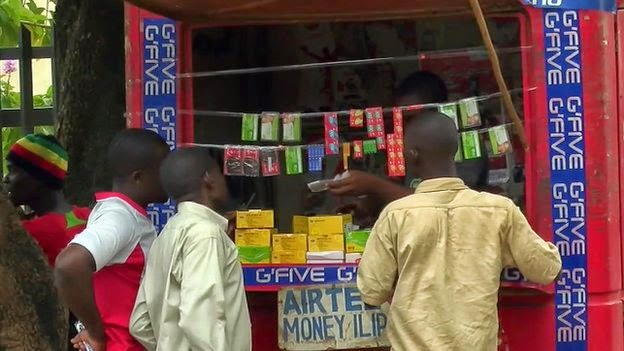
"There are times when the services are very bad, even the internet is very slow, so it's very frustrating," a woman in Lilongwe told me.
"Sometimes you want to make a quick call but then you can't get through, so those are some of the things that I think they need to improve," she said.
But in order for the services to improve, the government says it needs to upgrade existing infrastructure, especially in rural areas.
The authorities admit this could take up to five years, meaning consumers will have to continue incurring high costs for some time to come.
Source: ITU: Measuring the Information Society Report 2014
[Additional reports]


![UPDATE: Tragedy Struck as a 2year old Dies in an Accident involving a 22 year old Nigerian [PICS]](https://blogger.googleusercontent.com/img/b/R29vZ2xl/AVvXsEg9a486L890zV-rtiasK-JRO8rS1Hjt_SIBK5y974bHUMwifF6o_LrGc5zyDdeBKgJW8psuy5Rpm_2KTc7MHUEpmjSP9GTwaIbMHx2TDqrC_MmIVQdohnQcZltq24mSwqNS7YlyFoWGwSpf/s72-c/car2.PNG)
![New Video!!: Happy Day - Patoranking [download audio + video]](https://blogger.googleusercontent.com/img/b/R29vZ2xl/AVvXsEjc_gPmpP9YFIZPJ6vVk7FgGfEloeTOzJlcvxyjmcGZD3ObXq9nAF2q_XjWrSbFsWso0ZQbET2UtHjgk-WkThkT3xslKjNkruYiTJO539Hfnm3EpYbzpNrpVVsrGy2T5qNfxDdCyNEVmNU/s72-c/PATORANKING.JPG)

![HIP HIP HURRAY! 1[ONE] YEAR Anniversary of Scanty Gela BLOG. Celebrating AWESOME.](https://blogger.googleusercontent.com/img/b/R29vZ2xl/AVvXsEglMcNlmovvC2F-bv5S8mDQxG6JE0VpLfUm-OeRRqD59b651c9C8qQXXXrwX7E48Wm-2u3uBTAx9ajaCEJHLhDTdQzG41ZTqvP8sHJ4XImzTwhLNlncyoiGVZDt-WtLnJnAxPXR5ewQT7k9/s72-c/anniversary1.JPG)
![ASGA Nominations 2016: The Complete List of Nominees [EMU]](https://blogger.googleusercontent.com/img/b/R29vZ2xl/AVvXsEh4s8Ty0HnaZtQu06y-v2PbDSckvPWkm3V0O9rE_6jdZySq42ODHkK2kzI7NeRTeIzXzc0c3QT_Df_6MZzNR55cIW_CcNEkamHF_8USUjrC-pk4sImWdCFvLc4mNorKUtHFwoOn2onA7-lt/s72-c/asga2.JPG)
![EMU BUS SERVICE: 2014/2015 Transportation, Route, Rules and Time [UPDATED]](https://blogger.googleusercontent.com/img/b/R29vZ2xl/AVvXsEjAoFlTZSCwPslwBuQQfrkLgcEHHpsyQ-o8cQfBJNAug1uADTVSICvj1TxZDtRHXxPu-fwIQqDdvMcBFM-jm5XI5CU_NFRGM12dduFYqgpH3XhpbuK8tp6sIKj0MRF5u4e1O7HxZ1WbfXo/s72-c/emu-bus-service.JPG)

![#Flashback: EMU Students air their views on how important money is in a Relationship [COUCH TV]](https://blogger.googleusercontent.com/img/b/R29vZ2xl/AVvXsEgTVc2KEEY81d3sjdpZ8zJzEBH1T97BLDU7aRI_Zz3TKrQfhCotUgXaSNtS_8j6aIIThzOQDJ1_m9MdaojZlTaW5iCE8xiR6jn7oachOHafVvcHqAnSthRBla2x9ecxSCQE474CR0Qx5mzM/s72-c/video1.PNG)
![AFRICAN Comedy: featuring Chief Obi - "The Musician" [WATCH Video]](https://blogger.googleusercontent.com/img/b/R29vZ2xl/AVvXsEgPhZWxwW7mC48aTZ5KHWR1PSkqMZ9BL36vtmqDDy2AoG2tODaaFn83JHm7HIvTIlxkKDolbfTxcU7oyp0FkzlLWuRyPQWo2eIigD9SHW9J3WDdG43jAVy3i1eCqS8lbeKg3weywnExlxdp/s72-c/chief-obi.PNG)
![Fresh Music: Yungtizzer - All She Needs #Freestyle [download audio + video]](https://blogger.googleusercontent.com/img/b/R29vZ2xl/AVvXsEiyiyHWfkO8uDC5G0OP_MHCKhbxoNBpKy-2pvMezLZ70MgPNSe0peQjKlWPbNVcS1kFxDxVkm3VwKcWNkMwUiAn-IblpYDqo7yUHYjpmrd4-jvuWo6tcKj-PQLJRnnBKDcdoXcenpzQk-E/s72-c/tizzer.JPG)