Highlights

Showing posts with label Pharmacy. Show all posts

RESEARCH: Picking your nose is not only disgusting - it can also be really dangerous


There's no official figure on how many adults occasionally have a quick pick, but our estimation would be '99 per cent of them'.

But aside from the fact it's seen as a bit gross and uncouth, IS having a surreptitious little pick such a bad thing?

Stop picking your nose

Yes, according to Dr Erich Voigt. Not just bad either - but dangerous.

Speaking on a Business Insider video, Dr Voigt explains how introducing germs into your nose such as Staphylococcus aureus ("a germ which can live in the front of the nose"), combined with picking can cause abrasions.

As a result, these abrasions "bleed, promoting germs, increasing the crust and irritation by picking your nose."

Depending on where you are and where your hands have been, this could introduce some serious nasties into your body.

READ MORE 
Learn more »

The Pharmacists Council of Nigeria-PCN officially accredits EMU Pharmacy Faculty


The Pharmacists Council of Nigerya (PCN) ably represented by their representatives, Nigeria Pharmacists Council Chair Mohammed N. A. Elijah, Council Education and Internship Department Chair Dr. Idoko Anthony Sule, Nigeria Maiduguri University Pharmacy Faculty Dean Prof. Dr. Isa Hussaini and Nigeria Abuja Federal Health Ministry representative Zainab Ujuud Shariff visited EMU on 11th June 2016 with the intention of accreditation of the EMU Pharmacy Faculty.

The visit which was deemed a successful one saw the Nigerian representatives carrying out inspections on EMU Pharmacy Faculty and the university campus. On hand to receive them were EMU Pharmacy Faculty Dean and academic staff members. Information to the visiting group regarding the activities and education quality of the faculty, laboratories, accommodation and catering services provided for students, institutional structure, university and state support, sustainable quality and financial structure and international status of the faculty were provided. The visiting group of officials also met Nigerian students and received their views and questions.


Dean of EMU Pharmacy Faculty Prof. Dr. Fethi Şahin thanked the visiting officials for their support and added that EMU Pharmacy Faculty is the first and best pharmacy faculty throughout the island. Prof. Dr. Şahin also added that their short term mission is to become the best faculty of pharmacy in the Middle East region. Finally, Prof. Dr. Şahin put forth that the application process for the opening of the doctoral degree program in their faculty is now complete and that the faculty is awaiting the Turkish Higher Education Council’s approval.

[Source]
Learn more »

Your dream of a world without mosquitoes is one step closer to coming true


There are roughly 3,500 species of mosquitoes. But only around 100 bite humans and as few as 30-40 are responsible for the transmission of the most deadly diseases that routinely hobble the world’s poorest and most disadvantaged people. Instead of battling the estimated 219 million annual malaria cases and the resulting 600,000 deaths that occur each year in a reactionary manner by treating the sick and spending millions on wide-spread preventative measures like long-lasting insecticide-treated nets (LLINs), we can eliminate the disease’s only vector directly, at the source.

Specific mosquito species can be made extinct using the same sterile insect technique (SIT) that has existed for over 50 years. It has been effectively used to eliminate species before for disease prevention in humans and animals. The technique has some subtle edges but basically reduces to releasing a large population of targeted, sterilized male insects into the wild that out-compete the wild male population for the (single) mating opportunity with their female counterparts. Repeated application of this technique can completely eliminate a wild insect population — sometimes in as little as one year.

Success in eliminating the species of mosquitoes that are the malaria vector could be followed by engineering the extinction of the vector species for dengue fever, which infects 50 to 390 million each year (causing 25,000 deaths) and also the mosquitoes that contribute to the 200,000 cases of yellow fever and the attendant 30,000 deaths they cause each year.

The short-term goals of a permanent mosquito eradication plan would prioritize and establish the species that need to be eliminated, the areas around the world where this elimination needs to be targeted first in order to succeed, and establish connections with suppliers who can provide enough sterile insects to implement these plans.

The medium-term goals would be to decimate the wild population of these species in large-scale pilot programs by releasing millions of sterile mosquitoes per day in infested areas. These marginal eradication efforts will bring with them marginal reduction in malaria and commensurate reduction in the pain, suffering, and economic/social destruction caused by this crippling disease.

The long-term goal would be the total eradication of these mosquito populations in the wild and the end of malaria, dengue fever, and yellow fever. Captive lines of all these vector species should of course be kept in labs to study and as a hedge against the unlikely futures in which unintended ecological consequences prompt us to reintroduce the eradicated species.

Learn more »

Chuks Chukuorah: Improperly stored canned food can kill you [Botulism]


There are many things we hardly put into consideration in our everyday lives and these things might be very disastrous to our health. I bought a can of Tomato Paste recently and i discovered it was improperly stored and there are lots of changes in the colour of the tomato paste, not considering the amount of money i spent purchasing the product. Ofcourse i threw it away. I value my health and so should you, thus necessitating the writing of this article.

ABOUT BOTULISM: 
...a disease caused by improperly stored canned foods, could be very fatal to health.

INTRODUCTION: 
Botulism is a paralytic disease that is caused by a gram positive, endospore forming bacteria called clostridium botulinum. The C. botulinum is found in soils and water bodies mostly and it produces spores which would give rise to its offspring under favorable conditions. Unfortunately, these spores also produce the botulinum toxin which is very lethal to humans even in quantities as low as 1 microgram. The conditions required for these to happen are as follows: anaerobic, low-salt, low-acid, ambient temperatures, moisture and a protein source. The botilnum toxin can be neutralized at high temperatures, but the spores are resilient at such temperatures. There are eight known strains of the bacterium and they include strain A, B, (C1, C2), D, E, F, G and H. Types A, B, E  and rarely F cause human botulism while C and D affect animals only. Type G was just recently discovered.


MODES OF ENTRY:

INFANTS: The bacterium gets a relatively nice environment within an infant less than a year, mainly because they lack the intestinal microflora that discourages the growth of the bacteria and they also have low levels of bile acid. This is called the infant botulism. They could get it by taking honey.

FOODS: Improperly canned foods are the major risk factors when it comes to food-borne botulism. There are other rare food mediums that one could get infected example fish.

WOUND: it is seen among intravenous drug users especially those that that inject street drugs example people using black jar heroine. The spores get into the body through the wound and acts in the presence of low oxygen.

INHALATION: this is extremely rare, but could be seen in an inappropriate botox volume taken into the body.

**********
        
SYMPTOMS: The classic triad which are bulbar palsy and descending paralysis, clear senses and mental status and lack of fever. In further description they could be stated as drooping of the eyelids, dyspnea, double vision, coma and death.

DIAGNOSIS: This could be done by testing a stool, brain scan, cerebrospinal fluid examination, nerve conduction tests, electromyogram, enzyme-linked immunosorbent assays, electrochemiluminescent tests and also definite diagnosis could be carried out.

TREATMENT: The contaminated agent could be removed by induced vomiting or enemata and it is heptavalent antitoxin. A ventilator and supportive care could also be needed.

PREVENTION: Avoid giving honey to an infant less than a year old, canned foods should undergo cook for botulinum toxin, tropical foods should be acidified before bottling and in general foods should be stored and preserved meticulously.

.................................................................................................................................

Written by Chuks Chukuorah [Faculty of Pharmacy - EMU]
 Revised and supervised by Ajiboro Temitope [Faculty of Pharmacy - EMU]
Learn more »

Discovery Science: 'Why are mosquitoes so hard to swat?'


Mosquitoes fly at about two kilometres per hour (1.2mph), which sounds slow, but at their size it's like you flying over a hundred times that! They are going blindingly fast for something that small.

You can't catch them for a few reasons. One, they see you coming. Their eyes are big and round and multifaceted, so they are quite capable of seeing above and behind themselves. You can't sneak up on a mosquito easily.

Second, your hand moves slower than they fly and has more distance to cover. The mosquito doesn't need to move far to get away, while your big and slow hand has to travel all the way to your head.

Lastly, the mosquito makes decisions faster than you. When you decide to hit a fly, a signal goes from your brain to your spinal cord to your arm muscles to start the hand in motion. The time it takes is a few milliseconds. But once the mosquito sees motion, a signal from its brain goes to its nerve cord to its wing muscles, and the time ends up being a fraction of a nanosecond. They think and act 100 times faster than you can. Your hand never really had a chance!

Matan Shelomi, entomologist
Air pressure from your hand also serves to blow the extremely light mosquito out from under it prior to impact, aiding in escape. This is why fly swatters are made of mesh, not a solid panel.

Keith Sibson
Insects have fast-acting, wired-in escape strategies. However... someone taught me once how to kill a house fly with your hands, and it works. The trick: when the fly is sitting on a surface, clap your hands together above the fly. The fly will see the motion and take off going up, flying into your hands just as they come together. Insect reflexes are fast, but also predictable.

Paul King
False, I can really consistently nail mosquitoes, even in mid-air. But I can never catch those dang flies without a swatter.

Jacob Vanwagoner
They're usually hard to see, and there's too many. Should you kill one, expect another one to be snacking on you in the meantime.

Anne W Zahra
One low-tech solution to mosquitoes is a box fan. Mosquitoes fly poorly as insects go, and if you have a steady breeze going, that seems to keep at least most of them at bay.

How do You kill mosquitoes?
Learn more »

NEWS: Update on PCN Visit, Turkish Cypriot Licensing Exams for Nigerian Students, et al...


Over the holiday, the leadership of NAPS had series of meetings with the dean to discuss issues concerning Nigerian Pharmacy Students on the Island.

On the 2nd February, 2016, NAPS took a bold step by holding a joint meeting with EMU authority through the office Vice Rector International and Promotional Affairs Prof. Hasan Amca to present her request,  Present at the meeting were the Dean Faculty of Pharmacy, Prof. Mustafa Fethi Sahin, NANS Turkish Zone President, Comrade Salim Hamza Ringim, NAPS National President, Fredrick Edeh, NAPS EMU President, Ajiboro Temitope, other at the meeting were Ozioma Ezeofor, Ethel Eloto and Jack Sambe.

NAPS National President presented the following agendas;

1. Pharmacists Council of Nigeria be invited to the island in other to inspect our facilities, curriculum and collaborate with the Pharmacy regulatory body of North Cyprus to enable our students practice efficiently in Nigeria with been subjected to undue treatments.

2. Nigerian Pharmacy students be given Turkish Cypriot licensing exams to be converted into the Nigerian license upon arrival in Nigeria to avoid complications of taking the Nigerian Licensing Exams.

3. The University to sponsor Nigerian Pharmacy students to participate in the forthcoming International Pharmaceutical Students Federation African Pharmaceutical Symposium in Mombasa, Kenya in June.

The requests received positive response as the Vice Rector responded by requesting letters to this proposals. And the Dean booked an appointment immediately with the Cyprus Minister of Health to discuss the licensing exams procedures, terms and conditions.


On 1st March, 2016, the Dean Faculty of Pharmacy, Rector’s office Representative, NAPS Officials visited Cyprus Ministry of Health to discuss modalities, terms and conditions of the licensing exams with the Minister of Health Dr. Omer Gur Mustesar and Cypriot Pharmaceutical regulatory body.

The meeting yielded positive response as the minister, after brief deliberations with the Pharmaceutical regulatory body insisted that license are not allowed for foreign graduates, but with help from the Dean, NAPS officials explained to the Minister that the license can be inactive in Cyprus while active in Nigeria so it can be converted in Nigeria.

More detailed explanations and discussion on PCN visit and licensing exams will be done in an expanded exco meeting/congress that will be called by NAPS EMU as decisions will be taken on some issues.


Best Regards

NAPS-EMU
Learn more »

Is Garlic Good For You? 7 Surprising Benefits Of Garlic For Optimal Health


Garlic is a highly nutritious vegetable with very few calories, containing trace amounts of other nutrients that contribute to its universal status of a powerful, beneficial healer. The natural medicinal ingredient, both as a fresh plant and supplement, can strengthen immune function and boost overall well-being.

The body-strengthening effects of this herb are thought to be due to its active ingredient allicin. This is what gives garlic its distinctive taste and smell. Whether you take your garlic powdered, salted, or minced or in supplement form, you can reap the surprising benefits of this multipurpose herb for optimal health.

1. Treats Acne

This herb can serve as a natural topical treatment to get rid of blemishes. Allicin, the organic compound in garlic, has the ability to stop the damaging effects of radicals and kill bacteria. Allicin produces a fast reaction with radicals, which makes it a valuable herb for treating acne scars, skin diseases, and allergies.

2. Treats Hair Loss

A head full of hair that smells like garlic could help in the treatment of hair loss. The herb’s extremely high sulfur content contains keratin, the protein hair is made of. This stimulates fortification and growth.

3. Fights Common Cold

Garlic’s allicin can serve as a health aid during times of illness. Rene Ficek, a registered dietitian and a lead nutrition expert at Seattle Sutton's Healthy Eating in Illinois, “Garlic cloves contain a healthy dose of allicin, but you may still need a few cloves per day to feel the effects.” However, garlic supplementation can also be used to ward off viruses.

4. Lowers Blood Pressure

A garlic supplement a day may help keep your blood pressure at bay. Its active compounds can significantly reduce blood pressure comparable to the effects of prescribed drugs.

Garlic is believed to activate the production of the endothelium-derived relaxation factor, according to Ficek, due to the herb’s high amount of polysulfides — sulfur — containing molecules. This leads to smooth muscle relaxation and vasodilation (widening of blood vessels), following the relaxation of the smooth muscle in the vessel wall. Garlic supplements can achieve these effects efficiently without the bad breath compared to raw garlic.

5. Lowers Heart Disease Risk

Garlic can help lower the risk of heart disease by lowering total LDL cholesterol. A 2000 study published in the journal Annals of Internal Medicine found the effect of garlic on total cholesterol level in people with elevated levels moderately reduced cholesterol levels. Garlic supplements can enhance the body’s ability to dissolve blood clots that would otherwise increase the risk of heart attacks by closing the arteries.

6. Enhances Physical Performance

Garlic can help increase exercise capacity and reduce exercise-induced fatigue. Garlic oil has been shown to improve the exercise capacity of people with heart disease. A 2005 study published in the Indian Journal of Physiology and Pharmacology found participants with heart disease who took garlic oil for six weeks saw a reduction in peak heart rate by 12 percent. This was accompanied by an improvement in their physical endurance during a treadmill exercise.

7. Improves Bone Health

The alkalizing vegetable is filled with bone-healthy nutrients such as zinc, manganese, vitamin B6, and vitamin C. “Garlic is really high in manganese, which contains enzymes and antioxidants that facilitates the formation of bones and connective tissues, bone metabolism, and calcium absorption.”

In Conclusion, Garlic can be a flavorful addition to your dish and also double as a valuable aid to your health.

Credit: Medical Daily
Learn more »

Statement on the creation of The Nigerian Association of Pharmacy Students North Cyprus [NAPS]


With the growing need for us to spread our tentacles, widen our horizons and further consolidate our relationship with our counterparts here in North Cyprus and back home in Nigeria, it became imperative for a central body to be created.

Consequent to that, On the 30th of January, 2016 The Nigerian Association of Pharmacy Students North Cyprus (NAPS North Cyprus) was inaugurated by The National Association of Nigerian Students Turkish Zone (NANS TR Zone) with the following mandate;

1. To foster Unity among Nigerian Pharmacy Students in North Cyprus to help tackle health Challenges facing our dear country Nigeria by organizing programs such as, Seminars, Conferences, Symposiums, Health Awareness, Research, Trips and Social activities.

2. Invite the Pharmaceutical Council of Nigeria (PCN) to all Universities offering Pharmacy to help Supervise and give appropriate approvals to our programs here.

3. Work with the Turkish-Cypriot Government with help of Deans of participating schools to ensure that more traineeship and internship opportunities are provided for our students and Licensing examinations are administered to our students upon graduation to help reduce the intense pressure faced by international graduates during licensing examinations in Nigeria.

4. Work with sister societies and associations to inculcate basic norms into our members (especially freshers) and ensure that all Pharmacy Students are up to date with their educational-cum-social programs.

5. Work with other related international and national bodies to create international and national conference and congress opportunities for our members to improve educational and social exposures.

6. Work with all Universities with faculty of Pharmacy to source for more international accreditation from international licensing bodies in other to place the institutions in world standard. This will create a platform for a global recognition of our certificates.

The following emerged as the pioneer National Executives-

NATIONAL EXECUTIVE COUNCIL (NEC) 

1. NATIONAL PRESIDENT – FREDRICK EDEH (EMU)
2. NATIONAL VICE PRESIDENT - CHIKENDU MICHEAL OKEKE (CIU)
3. NATIONAL GENERAL SECRETARY - OZIOMA EZEOFOR (EMU)
4. NATIONAL PUBLICITY SECRETARY – UMAR USMAN SABO (EMU)
5. NATIONAL FINANCIAL SECRETARY -AUSTIN OGUNJOBI (NEU)
6. NATIONAL TREASURER - UYIOGHOSA ARIGBE (NEU)
7. NATIONAL EX. OFFICIO - OYINDAMOLA OLATUNJI (EMU)
8. NATIONAL EDUCATION DIRECTOR - MARY EFFANGA (CIU)
9. NATIONAL WELFARE DIRECTOR - ANJOLAJESU OLASOGBA (NEU)
10. NATIONAL EVENTS DIRECTOR - SIRAJUDEEN SHITTU (EMU)

Signed.
Umar Usman Sabo
(Publicity Secretary NAPS North Cyprus)

****

Proudly supported by Scanty Gela Blog
Learn more »

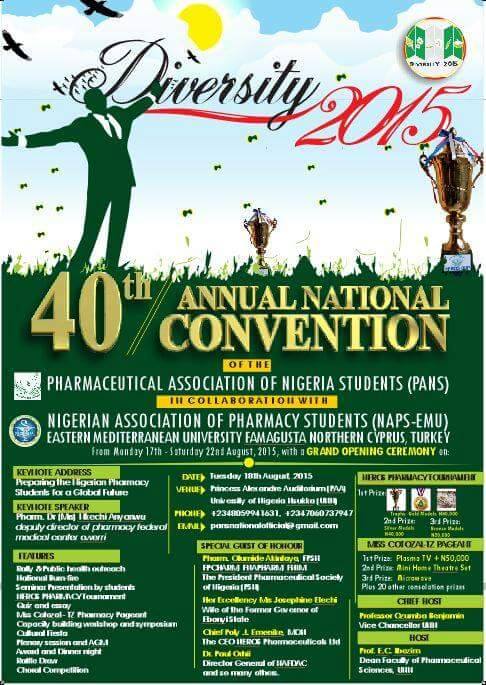
OVERVIEW: NAPS-EMU Excels in 40th Annual PAN National Convention Held in Nigeria.


It was a thing of joy as the Nigerian Association of Pharmacy Students Eastern Mediterranean University (NAPS-EMU), an umbrella body covering over 400 Nigerian students studying pharmacy at the Eastern Mediterranean University sent her delegates to witness and participate in the concluded Pharmaceutical Association of Nigerian Students (PANS) 40th Annual National Convention held at the University of Nigeria Nsukka (UNN), located at the eastern region of Nigeria, from 17th – 22nd August, 2015.

The 40th Annual National Convention that brought Pharmaceutical Students and “who is who” in the field of pharmacy home and abroad was hosted in collaboration with NAPS-EMU. Activities that took place at the convention was as follows;

*Rally and Public Health Outreach,
*National Burnfire,
*Seminar Presentation by Students,
*NEROS PHARMACY Football Tournament,
*Quiz and Essay,
*Miss Cotozal-TZ Pharmacy Pageant,
*Capacity Building Workshop and Symposium,
*Cultural Fiesta,
*Plenary Session and AGM,
*Award and Dinner Night,
*Raffle Draw and Choral Competition.

The Keynote address on “Preparing Nigerian Pharmacy Students for a Global Future” was presented by Pharm. Dr. (Mrs.) Nkechi Anyanwu, the Deputy Director of Pharmacy, Federal Medical Center Owerri.

During the Seminar session, one of NAPS-EMU leading seminar speakers, Ozioma O. Ezeofor spoke on one of the prevailing sexually transmitted diseases affecting the contemporary society “Lymphogranuloma Venerum (LGV) and indeed it was awesome.

NAPS-EMU Chairman, Senator Ajiboro Temitope Oluwole humbly represented by the leader of NAPS-EMU delegation Evangeline Samuel delivered a speech on behalf of the chairman.

The speech stressed on the importance of such National conventions to bring Nigerian Pharmacy students worldwide together to deliberate of the way forward and how to improve the pharmaceutical sector of our motherland and place our health sector in the front line of the global rating.

The 40th Annual National Convention was a huge success and some pictures to show the highlights of the events are as follows;


**Report Compiled By Comr. Fredrick Edeh

               (NAPS-EMU General Secretary)

Learn more »

Recent Study: Climbing Trees Significantly Improves Working Memory


Dynamic activities like climbing a tree could be a simple way to improve your working memory, new research suggests.

Researchers from the University of North Florida found that proprioceptively dynamic activities, meaning activities that require awareness of the position of different body parts and strength to complete movement, are linked to benefits of an individual’s working memory, as reported by Softpedia. These activities could include anything from climbing a tree to balancing on a beam.

Researchers also found that it doesn’t take much time to reap the benefits, as just a few minutes of such activity can produce beneficial effects on working memory.

Researchers evaluated participants between the ages of 18 and 59 while testing their working memory before and after the completion of various dynamic activities. Activities included climbing a tree, walking on narrow beams, running barefoot, and navigating obstacle courses.

The study found that participants experienced a 50 percent improvement in their working memory after completing these exercises while assessing their cognitive skills.

“By taking a break to do activities that are unpredictable and require us to consciously adapt our movements, we can boost our working memory to perform better in the classroom and the boardroom,” study leader Ross Alloway said, as reported by Softpedia. He emphasized that by doing physical activity that makes us think, we’re exercising our brains as well.

Those in the medical field say working memory helps humans actively process information, making it easier to perform day-to-day tasks and often increasing performance.

The findings were published in the journal Perceptual and Motor Skill.
Learn more »

UPDATED...NAPS-EMU cordially invites you to her "Dinner & Award Night" [Tickets on Sale]

NAPS-EMU cordially invites you to her "Dinner & Award Night" [6th July 2015 In order to bring the much stressful and mixed feelings semester and academic year to an end, the...NIGERIAN ASSOCIATION OF PHARMACY STUDENTS EASTERN MEDITERRANEAN UNIVERSITY NORTH CYPRUS  [click pic]


Learn more »

Awareness Video on HUMAN PAPILLOMAVIRUS [HPV] by NAPSEMU [Watch Video]


This awareness video on Human Papillomavirus [HPV] is produced to inform the world on the deadly nature of this virus and possible ways it can be prevented because for now there is no cure.

HPV is a DNA virus from the papillomavirus family that is capable of infecting humans. Like all papillomaviruses, HPVs establish productive infections only in keratinocytes of the skin or mucous
membranes and are capable of causing diseases such as persistent infection with high-risk oncogenic HPV of all cervical cancers, most anal cancers, and a subset of vulvar, vaginal, penile and oropharyngeal cancers. In recent time skin related beta-HPV types have been associated with the pathogenesis of non-melanoma skin cancers.

For more info on preventive measures, watch below.


For inquiries and sponsorship on subsequent videos, pls contact:

Nigerian Association of Pharmacy Students
Eastern Mediterranean University, Northern Cyprus.
Phone: +9050338866132, +905338868343, +905338733442

Email: officialnapsemu@gmail.com
Website: www.napsemu.com
Learn more »

Nigerian Association of Pharmacy Students [NAPS-EMU] presents "Impact of Infectious Diseases in Contemporary Society"

Nigerian Association of Pharmacy Students [NAPS-EMU] presents "Impact of Infectious Diseases in Contemporary Society"
[NAPS-EMU] is organizing an educative, health informative seminar that will change the world in times of spread and management  of infectious disease...
Learn more »

Near East University [NEU] Faculty of Medicine and Pharmacy opens first Info Centre


Founded through the cooperation of the Near East University Faculty of Medicine and Faculty of Pharmacy under the coordinator-ship of Assoc. Prof. Dr. Bilğen Başkurt, the Clinical Pharmacy Drug Information Center, which is the first center regarding this field in TRNC and Turkey, was inaugurated with a grand ceremony held at the Near East University Hospital.

Speaking at the opening ceremony, Prof. Dr. İhsan Çalış drew attention to the crucial role of patient-physician-pharmacist collaboration in ensuring rational drug use.

The centre will be offering a service from 09:00 till 17:00 five days a week.

A statement from the hospital said that the Clinical Pharmacy Drug Information Center will exert effort to provide patients with information regarding their drug therapies and appropriate use of the drug since the lack of information concerning the rational use of medicines is one of the most important problems.

Credit: EMU
Learn more »

Pharmacies in TRNC moved on to summer working hours from Monday 1st June.


As of the 1st of June, pharmacies across the TRNC will be open between 8am-1pm and 3pm-7pm.

While Pharmacies will be open between 8am and 1:30pm on Saturdays, on duty pharmacies will be open between 8am and 12pm.

The summertime working hours for pharmacies will continue until the 13th of September.

Credit: KP Daily news
Learn more »

NAPS-EMU On A Trip/Research and Field Trip to PHARMA MONDIAL, LEFKOSA-TRNC


An excursion trip to Pharma Mondial Limited Lefkosa North Cyprus was organized by the directorate of trip/research under Nigeria association of pharmacy students EMU on  27th May, 2015.

Pharma Mondial Limited Lefkosa North Cyprus is  a highly sophisticated company committed to the continuous development in manufacturing of pharmaceutical products.

The company possess a modern plant strategically located in N. Cyprus and designed by European experts, conform to the very stringent European and Turkish licensing requirements.

Since 1991, Pharma Mondial has created value and benefit to patients by transforming medical science into breakthrough solutions for OTCs, generics and food supplements, in tablet, capsule and liquid presentations; all by following the highest standards of The Good Manufacturing Practice (GMP). The products are intended for worldwide distribution.

Our plant is certified by UK- MHRA.

Quality stands at first place in Pharma Mondial as we operate under the Total Managements philosophy. Pharma Mondial puts special emphasis on caring for and being sensitive to legitimate concerns of all its partners, importers, distributors, and retailers, paying maximum attention to the patient health”. [http://www.pharmamondial.com/?/pharmamondial/]

The excursion trip was targeted at rekindling the enthusiasm of participants and morally boosting
the drive towards achieving incredible heights in the pharmaceutical industry and profession at large.

****

On arrival at the pharmaceutical company, a warm reception was received by the participants, the director Board of Management, Dr F. Ahandan presented a brief lecture, educating the participants on the operations, general conduct and step by step procedures on drug production.

After the brief lecture by Dr. F. Ahandan, a tour round the industry was performed by the participants, led by the assistants of the industry. After the lecture a brief presentation by the chairman of NAPS-EMU  Sen. AJIBORO TEMITOPE OLUWOLE stated how the trip will open a way for the two sectors to work together and this will futher enhance the relationship of the company with the Nigeria health sector at large.

More pics below:


 Some of the sections visited were;

Finished products storage room,
Quality control laboratory,
Raw-materials store,
Tablet coating area,
Drying room,
Sieving area,
Drying area after wet granulation,
Washing area for tools/materials,
Tablet compressing area,
Punch room,
Quarantine, Tablet quality control room (QC),
Sugar coating room,
Primary packaging area,
Secondary packaging area,
Ink-jet area, Storage room,
Empty packaging area.  

****

The excursion was a huge success as enormous knowledge was gained and enthusiasm built in the filed of pharmacy. Kudos to the director of Trip/Research, Mandy Uwadilachi Stephen and Evangeline Samuel for the effort to organize the excursion trip.

UPCOMING!:


Written by:
FRED EDEH
SEC-GENERAL NAPS-EMU.
Learn more »

COUCH TV: Annual Pharmacy Day in Eastern Mediterranean University [Watch Video 24:46]


[Published on May 26, 2015]

CouchTv  was present at the Annual Pharmacy Day to Bring to you All the very entertaining activities that took place there. This video captures exciting dances, dramas, presentations, etc at the South Campus EMU.
Watch video below:


Bonus Video:
Learn more »

Cyprus International University Faculty of Pharmacy celebrated International Pharmacy Day.


The Dean for the CIU Faculty of Pharmacy, Prof. Dr. Mehmet Koyuncu, and retired academic from the Eskişehir Anadolu University Faculty of Pharmacy Prof. Dr. Kemal Hüsnü Can Başer each gave a speech during a special event held at Çevik Uraz Conference Hall. The CIU Acting Rector Prof. Dr. Hikmet Seçim, and CIU Vice Rector Prof. Dr. Halil Nadiri were also present for the event.

In his speech Prof. Koyuncu pointed out that the CIU Faculty of Pharmacy, which opened in 2011 with 15 students, now boasted 192 students.  Expressing their pride at the rise in number of students enrolled at the faculty, Prof. Koyuncu said “Our faculty fully bears the responsibility for providing the most effective and highest quality education for our students within the domain of pharmacy. The pharmacists we educate here at CIU will become professionals with authority and responsibility at every stage of the process that stretches from the manufacture to the prescription of medication to patients”.

Pointing out that the CIU Faculty of Pharmacy aimed to become one of the most advanced faculties on the scientific and educational basis, Prof. Koyuncu underlined that the Faculty students were also members of EPSA (European Pharmaceutical Students Association), which meant that they took part in the meetings and conferences held by EPSA.

Prof. Koyuncu also stated, “I sincerely hope that we will be able to commence offering the programs Pharm. D. and Ph.D. in the near future, when we get installed in our newly constructed building, complete with an exhaustive academic team”. Explaining that they would see their very first students graduate next year, Koyuncu said “The rising number of Faculties of Pharmacy in Turkey and Cyprus, and recently established restrictions concerning opening of pharmacies are matters that need to be taken into consideration by students who will be graduating from the Faculty of Pharmacy”.

Speaking later, Prof. Kemal Hüsnü Can Başer, formerly of the Eskişehir Anadolu University Faculty of Pharmacy, gave a speech about the flora of Turkey as a source of medicinal herbs.

Following their speeches, students in the CIU Faculty of Pharmacy gave a presentation about the dangers of smoking.

Credit: CIU
Learn more »

Do you know why you get bitten by mosquitos? Here are 5 reasons why...


1.       Our breath smells GREAT
For mosquitoes, “any type of carbon dioxide is attractive, even over a long distance,” according to Joe Conlon PhD, technical advisor to the American Mosquito Control Association – so it is almost inevitable that we will attract the occasional insect.
Mosquitoes use an organ called the maxillary palp to detect carbon dioxide, and can detect it from over 150 feet away. So animals who exhale more CO2 naturally have an increased likelihood of attracting insects.

2.       The more active, the more attractive

Exercise produces more sweat, body heat and increases our CO2 emission, so we're more obvious to mozzies and our blood is tastier.

Not only is there more delectable detritus (organic material made up of dead skin and other waste products) building up on the skin when we exercise, but our increased breathing rate means our CO2 emission is higher.

Mozzies also hunt down their victims by detecting lactic acid, uric acid and ammonia, all of which are produced through intense exercise.

3.       They like beer
Evidence suggests that those who enjoy a boozy drink or two are more likely to be bitten by insects – this is because it affects your sweat production and skin temperature.

4. You're lovely and warm
Pregnant women attract double the amount of mosquitoes as they are about a degree warmer than other people, and they exhale roughly 20% more carbon dioxide. Tasty.

5. You have great taste in clothes
Wearing dark clothing can make you stand out to a mosquito; reds and purples are particularly vibrant for mosquitoes. To reduce your chance of being bitten, simply wear light coloured clothing.

Wanderlust
Learn more »

Earthworms rain down from skies over Norway, puzzling scientists


Meteorologists and biologists have been left baffled by earthworms raining from the sky over Southern Norway.

According to Norwegian news service The Local, the most recent phenomenon was discovered by biology teacher Karstein Erstad while he was skiing in the mountains.

“I saw thousands of earthworms on the surface of the snow,” he said.

“When I found them on the snow they seemed to be dead, but when I put them in my hand I found that they were alive.”

He thought they might have crawled through the snow, but rejected this idea, as the snow was over half a metre thick across the mountains.

This is not the only time an area experiencing worms raining from the sky in Norway, with other cases found in Molde and Bergen, both in the south of the country.

One popular theory on random animal rain suggest that the worms may have been lifted up by a violent air pocket and then brought back down miles away from where they started.

Another theory says water spouts, weather systems similar to tornadoes, can travel from seas onto land and pick up vegetation, debris, and small animals, carrying them miles away from where they started before they blow themselves out.

...Read more
Learn more »

_

RealTalk Undressed