Highlights

Showing posts with label North Cyprus. Show all posts

The Cyprus Declaration: a pragmatic way to reunite the island [by Alper Ali Riza]


THERE HAS never been a generation better qualified than the present nor a time more opportune than now for the people to decide how to put Cyprus back together again.

This generation is better educated; more widely travelled than ever, with broader horizons and with the benefit of 21st Century information technology, and should be asked to participate directly from the outset in order to provide the prior consent that is crucial to uniting Cyprus in a bi-zonal federation of two constituent states.

There are also many good people of the older generation on both sides with the wisdom of hindsight who lived through the terrible events of 1963 and 1974 and experienced at close range the awfulness of war and displacement who have waited far too long and who would wish to have an opportunity to vote about the future of their country in the hope that they will leave behind a peaceful future for their children and grandchildren.

The region around Cyprus has become a dangerous place too and danger concentrates the mind of most people. It is an ill wind that is blowing across the sea, which makes it essential to unleash the common sense of the people to help sort out the Cyprus problem once and for all before it is too late.

The joint statement in Cyprus of 11 February 2014 reserves to the leaders the ultimate decision to agree the settlement first before it is put to the people in simultaneous referenda.

However in the 2004 referendum seventy five per cent of Greek Cypriots rejected the Annan Plan, and although they are not to be taken as having rejected a bi-zonal federation as such, the result of that referendum has to be shown respect if the same result is to be avoided.

The way to show respect is not to carry on regardless, but to hold a referendum and obtain prior consent first, this time round.

The truth is that a bi-zonal federation is still very controversial among Greek Cypriots because it arises from a state of affairs that was not freely chosen but was the result of the tragic events in the summer of 1974, and as such has to be promoted with sensitivity as well as pragmatism.

The Greek Cypriot people need to be persuaded and the persuading needs to be convincing. And the arguments are persuasive and convincing!

Advantages of direct democracy

The use of direct democracy in a referendum at the outset is not intended to replace representative democracy but to enhance it by relieving the political leadership of the responsibility for decision-making that is so profound and of such historical and national importance that no individual or institution in a modern democratic society should be expected to carry such a heavy burden within the constraints of their democratic mandate.

The Rationale behind a bi-zonal federation

The rationale behind the bi-zonal federation is that owing to events on the island from 1963 culminating in the 1974 war, Turkish Cypriots fled to the north of Cyprus en masse in fear for their lives and are now unwilling and in some cases unable to return to their former homes in the south of Cyprus.

As they are now concentrated in the north and not interspersed throughout the island, it is proposed that the previous constitutional arrangements are altered to enable them to govern themselves within a sovereign United Cyprus in political equality under a new federal constitution comprising two constituent states known as ‘North Cyprus’ and ‘South Cyprus’.

Political equality

Political equality has been much misunderstood by its proponents as well as its detractors. Political equality is what Cyprus has in the councils of the EU. In important decisions, for example, whether to admit a new member, Cyprus, a country of less than a million people, has equal voting power with Germany, a country of more than 80 million people.

In theory, Cyprus could for example veto the admission of say Ukraine even if all the other states wished to admit her.

The example shows that it all depends on the importance of the area of decision making involved but the underlying rationale is that in important areas of governance majoritarian domination is regarded as problematic and undemocratic.

Contrary to the received wisdom among Greek Cypriot politicians in the past, majoritarian domination is capable of being problematic and undemocratic in Cyprus too, hence the need for political equality in important areas of executive and legislative decision-making whereby both entities of the federation would have to agree a measure if its area of operation triggers the political equality provisions of the Constitution.

It is not difficult to imagine which areas would activate the trigger but that must be for the leaders to negotiate, with a further referendum if they fail to agree.

The property aspects

The property aspects of the problem have to be compatible with the European Convention on Human Rights but it is important to note that the right to property is a qualified right that may be curtailed in the public interest if necessary and proportionate to a legitimate aim, provided the loser is properly compensated.

The property aspects shall be dealt with by compensation exchange or reinstatement. Some of this is already taking place privately in accordance with procedures put directed by the European Court of Human Rights.

The land to be returned under ‘South Cyprus’ control is a matter for negotiation for the leaders.

The federal civil service

The federal civil service poses its own set of problems. People who are not civil servants are concerned about the size and cost of a bloated civil service and the integrity, competence, and efficiency of state officials more than their ethnicity.

The aim must ultimately be to have a much smaller state apparatus but of such high quality that in years to come ethnicity would no longer matter.

In the initial stages of any solution however it would be impossible for the putative federal civil service to be up and functioning from nowhere.

To this end it is proposed that in the event of an affirmative response in this referendum there is set up, with the assistance of the EU, a Graduate School of Administration in the mould of the Ecole Nationale d’administration in France, to train and prepare the very high quality civil service that will be from both sides who will take over the levers of federal power once the federation is launched.

Preparing for a solution in practical terms is one of the best confidence-building measures imaginable which is the reason why an affirmative answer in this referendum is so important. To this end it is also proposed that soundings begin with the EU as soon as possible concerning setting up the said Graduate School.

Membership of the EU

Cyprus shall continue to be a member of the European Union. The Turkish Cypriots have already voted indirectly in favour by their affirmative vote in the 2004 referendum on the Annan plan, since the idea at the time was for Cyprus to be reunited so as to join the EU problem free.

The importance of this area of common ground is that it is very conducive to resolving the Cyprus problem because membership of the EU carries with it transfer of sovereignty to the EU which reduces areas of potential disagreement.
.

Foreign policy and Turkish guarantees

Foreign policy is not normally controversial at home. If it were not for the Cyprus problem, the foreign policy of Cyprus would be like that of Malta, which is perhaps why some politicians in Cyprus indulge the Cyprus problem.
Turkish Cypriots place a lot of importance on Turkish guarantees.

They should consider a fresh look at how efficacious such guarantees are in international law because even if the treaty of guarantee remained in force Turkey would still only be able to intervene lawfully if it could invoke self defence under the UN Charter.

Troop withdrawals and resettlement of Turkish nationals back to Turkey should not in principle pose insuperable problems because as and when a solution is found the natural consequence must be that the Turkish troops would gradually be withdrawn because their presence would be redundant.

So far as the resettlement of Turkish nationals is concerned, EU and European Human Rights law would govern their position as well as what the two sides agree. Objections from Turkey or from Turkish Cypriots about these matters are much exaggerated.
This declaration aims to persuade all the people, but particularly the Greek Cypriots, to vote in favour of a bi-zonal federation as a pragmatic way to reunite the island. It is acknowledged at once that it is put forward for want of anything better but in democracies this is often the best reason. It is measured in tone, close to the facts, sensitive to feelings and true to itself. We recommend it to the people of Cyprus.

Alper Ali Riza is a Queen’s Counsel and one of HM part time judges in England
Learn more »

Anadolu Agency - What could a 'new' Cyprus look like?


Turkish Cypriots and Greek Cypriots could face the biggest decision of their lives this year if current peace talks lead to their divided island's reunification.

A professor of political science and international relations at Northern Cyprus-based Eastern Mediterranean University, Sozen – who has spent 20 years on the Cyprus conflict – talked to Anadolu Agency. 

In other words, everyone on the island would be citizens of a united federation; however, they would be educated in their own schools in their mother tongue and live under their own autonomy.

Therefore, the island’s unification would bring more gains for Turkish Cypriots than Greek ones, because Turks would be EU citizens in the end.

The Turkish side of the island would use the euro [official currency of the eurozone which consists of 19 of the EU’s member states] instead of its current currency, the Turkish lira.

President of the Turkish Cypriot Chamber of Commerce, Fikri Toros, who is also a businessman in Northern Cyprus, claimed that Cyprus’s employment capacity would rise sharply after unification, especially in tourism – the island’s main source of income.

[Source]
Learn more »

UPDATE: Cyprus’ New Division - 2 Different Time Zones now a Reality [by EVIE ANDREOU]


NICOSIA, aside from being the only divided capital, as of today is now also probably the world’s only city of its size to have two time zones following the decision in Northern Cyprus not to return to daylight-saving time, which came into effect some while back.

There is now a one-hour difference between the north and south of the island with the Turkish Cypriots remaining an hour ahead and while many find it amusing, there will be practical issues, especially for Turkish Cypriots who work in the south of the island.

The decision, which was announced last month was mostly met with amusement from many Cypriots on both sides.  But TRNC Government said that it was necessary for practical reasons. Last year Turkey waited a week to fall in line with the rest of the world before changing to daylight saving time, causing frustration both in Turkey and in the north as computers and smartphones automatically dialled back an hour.

Turkish Cypriot leader Mustafa Akinci had said in September that it was deemed as necessary purely for practical reasons and he dismissed arguments linking the move with political criteria. He added that they wanted to avoid problems with flight schedules, as in the north planes arrive only from Turkey. Another reason, he said, was to also avoid a change in the rules of the market and an effect on the financial sector. “If you ask me I surely do not wish for different time zones on our island,” Akinci had said.

The way out is a solution of the settlement agreement so that they could “rid” themselves from “unnatural things like this,” he added.

“We divided this island and now we will also have two time zones. This is absurd and unacceptable,” Bariş said. “In my opinion, we have to solve the Cyprus problem to solve this”.

Commenting on the decision taken by the Turkish Cypriot side to implement Turkey’s decision to stick to summer time all year-round, a spokesman of the UN Peacekeeping Force in Cyprus (Unficyp) had said that they were focusing on facilitating efforts to reach a comprehensive settlement as soon as possible and that it was up to the two sides “how to address such issues”.

“The idea began as a joke. We thought about it the night Turkey had announced it wouldn’t follow the daylight-saving changes and when they decided in the north to do the same, we launched the event and it became viral,” Tanur Tsiknakis told the Sunday Mail.

Having two time zones, she said, it will be confusing. “It will be difficult as I’m a Turkish speaking Cypriot and my husband is a Greek speaking Cypriot and it will create problems. We have family on both sides of the divide,” Tsiknakis said.

[Source]
Learn more »

United Nations, Espen Barth Eide : "There is no time to waste to achieve a Cyprus settlement"

United Nations, Espen Barth Eide : "There is no time to waste to achieve a Cyprus settlement"
There is no time to waste if the two community leaders want to reach their target for a Cyprus settlement within 2016, UN Secretary-General’s Special Representative on Cyprus Espen Barth Eide has said....READ MORE
Learn more »

YUSUF KANLI: Nailing Jelly to the Wall - The Cypriot Problem [OPINION]


Last weekend I was at a rather interesting Cyprus seminar. The meeting itself was a very important one as the Strategic Research Institute (USAK), in cooperation with the Cyprus Academic Dialogue brought together Turkish, Turkish Cypriot and Greek Cypriot academics, journalists, and of course some senior politicians in Ankara. Particularly for Greek Cypriots being in Ankara and sitting around a table with some key Turkish Cyprus pundits and top bureaucrats was precious. “Look at the invitation to this conference! ‘Turkey and Cyprus Regional Peace & Stability.’ Turkey and Cyprus in one sentence. That in itself is the biggest accomplishment of this seminar,” Nicos Anastasiou, President of Cyprus Academic Dialogue said. Of course when looked at from Ankara, there was nothing important in that sentence, but for Greek Cypriots who have been aspiring for decades to bypass Turkish Cypriots and directly talk with Turkey, it was an emotional success.

For ages, Greek Cypriot leaders have been stressing that they should directly talk with Turkey, rather than Turkish Cypriots because it was Ankara that makes the decisions. That assumption was not, unfortunately, wrong all together and indeed reflects the bigger and the lesser threats the Turkish Cypriots indeed have been facing. Turkey must accommodate itself to the reality of the Turkish Republic of Northern Cyprus (TRNC) and start state-to-state relations with Turkish Cypriots. The Turkish Cypriot state is recognized only by Ankara, but that Ankara has become some sort of a colony power as well.

Which is the bigger threat, Greek Cypriots who deny the existence and equal rights of Turkish Cypriots in the governance and sovereignty of Cyprus or Turkey, a country so affectionate and embracing the Turkish Cypriots so strongly that breathing has become almost impossible?

Well, there is even a third threat. Defeatist leftist or liberal Turkish Cypriots… Can there be lasting peace with a defeatist or self-defeating mentality? Can surrender and altogether submission to the demands of the “other side” manage to bring a sustainable resolution to an intractable problem, at the core of which lies in one of the two sides’ refusal of political equality and share in governance, as well as in the sovereignty of the other partner.

Her eyes wide open in anger, a young female colleague was yelling at me the other day that as someone who supported the TRNC was not expected to be a supporter of a federal solution on Cyprus. Strange. A Greek Cypriot friend, attending the same event, was talking about how Turkish Cypriots might patch up the unitary state of the Cyprus Republic, enjoying full individual rights like Greek Cypriots, and thus transforming the state into a functional federation. He was all together rejecting any settlement prospect other than the federal one, but his description of the federation was nothing further than changing the name of a unitary state. The Greek Cypriot friend was definitely sure that by transforming the republic into a federation buy adding to it the “Turkish Cypriot element” and re-writing the Constitution with a federal approach, the Cyprus problem could become history.

A Turkish Cypriot professor, presenting an awesome confidence building package that indeed was calling to approach the Cyprus issue through a compartmentation approach, suggested the Turkish side demonstrate its goodwill and will for settlement by taking some unilateral moves. What kind of moves? Transferring the ownership of some key religious institutions – such as the Apostolos Andreas Monastery and the Hala Sultan Tekke (Islamic monastery) – to their rightful owners. He also suggested that Turkish Cypriots could as well stop customs applications at border crossings, as if those gates are customs gates of “another state.” Why? All sorts of consolidation of TRNC must be avoided while moves demonstrating the will to recognize, at least tacitly, the Cyprus government must be undertaken.

Greek Cypriots, to show goodwill as well, might retaliate to Turkish Cypriot “confidence building” steps by allowing the Ercan (Timbou) Airport open to international flights. How? Under Turkish Cypriot rule, but subject to Greek Cypriot FIR and regulations. To show goodwill it was of course advisable for Turkey to open its ports and airports to Greek Cypriot planes and vessels and, of course, there is no merit in holding the deserted Varosha suburb of Famagusta a hostage of the deadlocked peace talks, and it must be handed over to Greek Cypriots bona fide at once. What else?

No one spoke about the need for Greek Cypriots to take unilateral steps, or to start acknowledging, if not recognizing, the existence of a functioning – indeed better functioning – democracy in the north. Cyprus talks of all sorts have become something like trying to nail jelly to the wall.

Credit: Hurriyet Newspaper
Learn more »

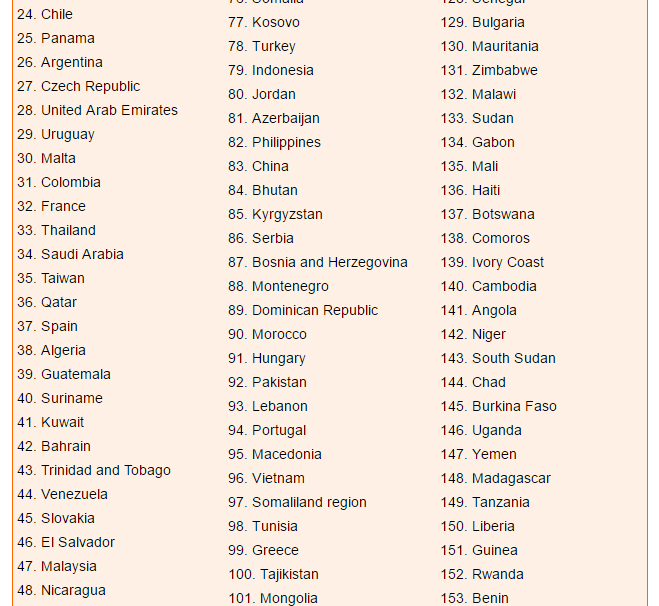
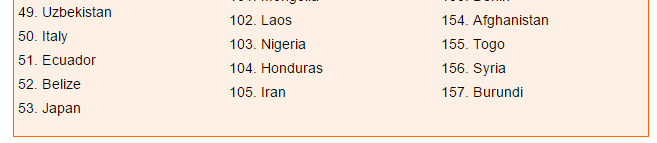
North Cyprus 62, Turkey 78 and Nigeria 103: Happiest Countries in the World Latest Ranking 2016


Denmark has emerged as the happiest nation in the world. The Scandinavian country, which has a population of around 5.6 million, knocked Switzerland into second place to take the title of the happiest country in the 2016 World Happiness Report.

A combination of a relatively high GDP, good healthy life expectancy and high levels of social support gave the country its edge over the other nations.

The report is the fourth of its kind to be produced, using a variety of factors to measure happiness around the world since the first World Happiness Report in 2012.

People's health, access to medical care, family relations, job security, political freedom and levels of government corruption are all among the measures used to assess happiness.

Check out the list below:


Credit: Daily Mail UK
Learn more »

BRACE UP CYPRUS: End of Spring and Summer set to be Very Hot and Dry


EU weather officials are predicting dry weather for Cyprus spring ending and all through the summer with less rain and higher-than-normal temperatures.

Following a particularly dry winter with less rainfall levels than normal in Cyprus, the Serbian Meteorological Service that monitors the entire region has issued a forecast for the island where the first warnings of a drought are starting to appear.

Total rainfall for the months of March, April, and May is expected to be less than normal by 50% in the south and southeast of the island and up to 75% in other areas. Temperatures are not expected to veer off drastically from normal levels but they will show a slight increase, adding to the already hot characteristics of a summer drought.

Expected temperatures of up to 45'C will be observed during the highest peaks in Summer. Residents are advised to be cautious and wear protective clothing.

Credit: In-Cyprus
Learn more »

The Famagusta Initiative Event in support of reunification and peace in Cyprus [overview]


The event, which made a re-ference to the pre-1974 orange festivals in Famagusta, started in the morning of 19th March 2016 with a religious service within the walled city.

The Famagusta Initiative together with Famagusta-Our Town groups organized the bicommunal event titled ‘Oranges in the Sea’ on the shores by the closed-off city of Varosha last weekend in support of reunification and peace in Cyprus.

The Turkish Cypriot and Greek Cypriot participants of the event then proceeded to the Palm Beach shore where they released 42 paper boats in yellow, orange and green to the sea.

Forty-two symbolises the number of years since the division and the yellow, orange and green colours symbolise the colours of citrus colours, the organisers said.

The participants also decorated an old Famagusta orange festival float with oranges; the float is an original that had been used during the pre-division festivals.

A children’s choir sang songs in Turkish and Greek, and a human chain was also formed along the shore to call for peace and unification.

Some 500 Greek Cypriots came from Limassol, Nicosia, Larnaca and Paralimni to participate in the event.

A similar event, ‘Oranges on the Sand’, was organised last year by the Famagusta Initiative and Famagusta-Our Town.

Credit: In-Cyprus
Learn more »

METU University Announcement: Application for Fall 2016 will open at the end of March!


25%,50%, 75% & 100% Tuition Fee Waiver Scholarships on Admission!

Dear Applicant,

Thank you for your interest in Middle East Technical University Northern Cyprus Campus (METU NCC).
 
Application for Fall 2016 will open at the end of March. The exact date will be announced in the mid-March.
 
Please visit our prospective students and admission requirements pages  prior to your application: http://international.ncc.metu.edu.tr/admission-criteria-for-your-country
 
Note: in case you are not sure whether you meet the minimum requirements for application or not, please contact us for advice.

If you have any questions, please contact us via nccmetu.edu.tr  or call +90 392 661 21 07 Est: 09, 10

****
METU TRNC

****

This is a sponsored post
Learn more »

Statement on the creation of The Nigerian Association of Pharmacy Students North Cyprus [NAPS]


With the growing need for us to spread our tentacles, widen our horizons and further consolidate our relationship with our counterparts here in North Cyprus and back home in Nigeria, it became imperative for a central body to be created.

Consequent to that, On the 30th of January, 2016 The Nigerian Association of Pharmacy Students North Cyprus (NAPS North Cyprus) was inaugurated by The National Association of Nigerian Students Turkish Zone (NANS TR Zone) with the following mandate;

1. To foster Unity among Nigerian Pharmacy Students in North Cyprus to help tackle health Challenges facing our dear country Nigeria by organizing programs such as, Seminars, Conferences, Symposiums, Health Awareness, Research, Trips and Social activities.

2. Invite the Pharmaceutical Council of Nigeria (PCN) to all Universities offering Pharmacy to help Supervise and give appropriate approvals to our programs here.

3. Work with the Turkish-Cypriot Government with help of Deans of participating schools to ensure that more traineeship and internship opportunities are provided for our students and Licensing examinations are administered to our students upon graduation to help reduce the intense pressure faced by international graduates during licensing examinations in Nigeria.

4. Work with sister societies and associations to inculcate basic norms into our members (especially freshers) and ensure that all Pharmacy Students are up to date with their educational-cum-social programs.

5. Work with other related international and national bodies to create international and national conference and congress opportunities for our members to improve educational and social exposures.

6. Work with all Universities with faculty of Pharmacy to source for more international accreditation from international licensing bodies in other to place the institutions in world standard. This will create a platform for a global recognition of our certificates.

The following emerged as the pioneer National Executives-

NATIONAL EXECUTIVE COUNCIL (NEC) 

1. NATIONAL PRESIDENT – FREDRICK EDEH (EMU)
2. NATIONAL VICE PRESIDENT - CHIKENDU MICHEAL OKEKE (CIU)
3. NATIONAL GENERAL SECRETARY - OZIOMA EZEOFOR (EMU)
4. NATIONAL PUBLICITY SECRETARY – UMAR USMAN SABO (EMU)
5. NATIONAL FINANCIAL SECRETARY -AUSTIN OGUNJOBI (NEU)
6. NATIONAL TREASURER - UYIOGHOSA ARIGBE (NEU)
7. NATIONAL EX. OFFICIO - OYINDAMOLA OLATUNJI (EMU)
8. NATIONAL EDUCATION DIRECTOR - MARY EFFANGA (CIU)
9. NATIONAL WELFARE DIRECTOR - ANJOLAJESU OLASOGBA (NEU)
10. NATIONAL EVENTS DIRECTOR - SIRAJUDEEN SHITTU (EMU)

Signed.
Umar Usman Sabo
(Publicity Secretary NAPS North Cyprus)

****

Proudly supported by Scanty Gela Blog
Learn more »

WEATHER UPDATE: Cold Front in TRNC ends – Warmer Weather Set For The Month


Temperatures throughout the island will begin to climb gradually as of Friday, effectively ending the freezing cold that has gripped the island lately.

According to the Meteorological Services’ official forecast temperatures starting as of today are expected to reach 13°C inland, 15°C on the coasts and 3°C in the mountains.

Temperatures are then expected to begin to rise noticeably tomorrow and Saturday, although, according to the forecast, isolated showers may make a return this weekend.

The cold spell from Northern Europe which started at the beginning of the week had brought unusually cold temperatures for this time of the year with night time temperatures dropping well below zero to -2°C inland, around 5°C on the coasts and -4°C in the mountains.

Credit: BRT World News
Learn more »

UN Secretary General’s Special Envoy for Cyprus, Eide: "2016 will be The Year of Solution"

UN Secretary General’s Special Envoy for Cyprus, Eide: "2016 will be The Year of Solution"
Eide stated that the solution of the Cyprus problem is extremely important for both sides in Cyprus. The two leaders sent the message from Davos that “2016 will be solution year for Cyprus”...READ MORE
Learn more »

Historical Nicosia interactive website launched


‘Nicosia: The story of a shared and contested city’ is a public history project aiming to provide the public and researchers with a historical overview of the city of Nicosia from 1878 to 1974. The project comprises seven interactive maps. The first map was created by Horatio Herbert Kitchener, and was the product of the first survey of Cyprus, conducted by him. The remaining maps come from the Land Survey Department of the Republic of Cyprus. The maps are enriched with demographic data, which are visually represented on each map and each respective municipal quarter.

On Friday, 15 January 2016 the Association for Historical Dialogue and Research (AHDR) presented to the public a new interactive website containing the findings of a three-year-long research project, undertaken by the AHDR with funding from Norway Grants 2009-2014, in partnership with the Council of Europe, in the context of the project “Home for Cooperation”.

This unique and innovative website aims at gathering together  information on the most significant landmarks of Nicosia, as well as a collection of short personal stories and public scandals that took place in our common capital during the period 1878-1974.

The launch of the website took place at a public event at the Home for Cooperation (H4C) in Nicosia where representatives of the main communities of Cyprus were invited to share thoughts and hopes on how this project could contribute to aknowledging and preserving our respective, yet common heritage.

The website is currently available on www.nicosiaproject.eu in English, with the Greek and Turkish versions due to be released soon.

****

For more information please contact the AHDR at: +90 548 834 5740 or email: ahdr@ahdr.info, or visit the AHDR website at www.ahdr.info
Learn more »

BRT NEWS: New mobile speed cameras to come to service in TRNC.


Police cars fitted with speed cameras will be able to detect speeding drivers while on the move as well as when parked.

New mobile speed cameras are to come into service as of the 1st of February 2016, the TRNC police department has announced.

According to a statement issued by the TRNC police department, speeding is the leading cause of traffic accidents in the country.

The statement said that a police vehicle fitted with the new mobile speed camera had completed tests and was ready to go into service.

The new speed cameras are capable of detecting and photographing speeding cars while on the move.

The police department said that it aimed to catch more speed offenders in a bid to lower traffic accidents due to speeding.
Learn more »

Cyprus during the Ottoman Period symposium held at Near East University [NEU]


‘Cyprus during the Ottoman Period’ Symposium was held as a result of cooperation between Near East University (NEU) and Municipality of Istanbul Bağcılar

Cyprus during the Ottoman Period symposium was held at the NEU Grand Library. A high number of participants attended.

According to the press info release by the Directorate of Press and Public Relations of Near East University, renowned academicians from universities of 8 different countries, historians, journalists and writers shared their knowledge, perspectives and views regrading ‘Cyprus during the Ottoman Period’.

The opening speech of the symposium was made by Mayor of Istanbul Bağcılar Municipality; Lokman Çağırıcı who expressed how pleased they were to be conducting this symposium in the TRNC. Science during the Ottoman period, religious and social life statuses, cultural and economic structures were examined closely.

Çağırıcı noted that the Ottomans had sovereignty over the island for as long as 307 years and during that time harmony and stability reined. The Ottomans reopened Catholic places of worship and Greek Cypriots had rights of say for the first time and the right to self-administration. Pointing to the water pipeline project now, Cagirici said that the project carried importance for both the Turkish Cypriots and Greek Cypriots.

Credit: Kibris Postasi
Learn more »

North Cyprus: The beautiful Mediterranean Island that time forgot [OPINION]


NATURAL WONDERS
Take the bumpy pass through the Kyrenia mountain range, known as the Five Finger Mountains thanks to their spectacular pointy peaks.

Stop and you’ll spot huge black hares, soaring Bonelli’s eagles, Cyprus warblers or any of the other 280 bird species which live here.

The bird to spot is the fabulously flamboyant hoopoe, with its zebra-print tail and outrageous orange and black-tipped crown.

And a trip to the north would not be complete without a stakeout to watch huge loggerhead turtles lay their eggs on Aligadi beach.


Females typically visit in May and late June to August. Blinking baby turtles scramble from their eggs to make moonlit sprints to the sea.

As a child, my mother would insist on driving from our home in Kibris to the top of the helterskelter roads in her roofless, yellow Mini Moke. These days, I prefer to go by foot

ESSENTIAL WALKS
Also in the Kyrenia range is St Hilarion castle, the island’s best-kept Crusader bastion.


As a child, my mother would insist on driving from our home in Kibris to the top of the helterskelter roads in her roofless, yellow Mini Moke. These days, I prefer to go by foot.

It’s not an easy climb to the top rampart, all 400 steep steps, but it’s worth it for views at the Queen’s Window, a stone archway that was once the bedroom of Queen Eleanor of Aragon.


DINING OUT
The whitewashed mountain village of Karmi is home to the Levant restaurant which has sweeping views of the castle.

Highlights include slow-cooked lamb shank and mussels sautéed in the local tipple, raki. Don’t leave without trying the signature dessert Mediterranean parfait: ice-cream with crushed sesame seed biscuits, tahini paste and local honey.

For a night of glitz and glamour, the fi ve star Rocks Hotel & Casino is the place to push the boat out.

At Kyrenia’s beautiful horseshoe harbour, La Habanera restaurant, with its art deco interior, has a resident pianist and serves fi ne pasta and some local specialities.


THE BEACHES
The Karpaz Peninsula in the north east boasts miles of golden sands and plenty of old monuments too. If you’re lucky, you may spot the wild donkeys that roam here.

Cypriots believe it to be the birthplace of the Goddess of Love, Aphrodite.

The best family-friendly beach is Glapsides where water is shallow.

The restaurant on the beach is the place to be in summer with hosted beach parties. You can also pitch a tent or rent a pedalo or kayak.

HISTORICAL SITES
Greeks, Romans, Arabs and Ottomans have left their mark on the landscape, architecture, culture and cuisine. Check the incredibly preserved ruins and mosaics at Salamis and imagine you are a Roman going to market.

Head towards the island’s dividing United Nations Green Line, and stand on the thick Venetian walls surrounding the fortified, sealed-off ghost town section of the city of Famagusta.

Kyrenia Castle houses the world’s oldest shipwreck, a tiny wine and olive trading boat that went down outside the harbour around 300BC. Kyrenia is a must-see, too, for its tiny, pretty, bustling port filled with fine fi sh restaurants.

WHERE TO STAY
Denizkizi resort has two hotels, The Royal and my favourite, the original Denizkizi, with its fine seaside position overlooking manicured gardens that seem to slope into the sea.

There are 56 rooms and a private beach with a fabulous seaside restaurant.

Sister hotel the Royal has fantastic facilities including a freshwater pool with a waterfall and a fitness centre that guests from either hotel can use.

Sitting in a lush valley, Bellapais Gardens is the closest North Cyprus gets to a boutique hotel and is the island’s most charming place to stay. There are bungalow-style studio bedrooms in this former monastery’s immaculate grounds.

The pool is set in the heart of what once was a vegetable and fruit garden, tended by Norbertine monks. You can swim gazing up towards the striking stone arches of Bellapais Abbey on the hill above.

*Written by Anonymous
Learn more »

GC President Anastasiades to Turkish daily Sabah: "The name my heart desires is ‘United States of Cyprus"

GC President Anastasiades to Turkish daily Sabah: "The name my heart desires is ‘United States of Cyprus"
In an interview published on Tuesday, Anastasiades also said: “During the conversation we had with TRNC President Mr. Akıncı regarding the name of the state... he said [Click to read more]
Learn more »

The Department of Labour Inspection issues warning to workers as heat rises across Cyprus


The Department of Labour Inspection [DLI] has warned employers that high temperatures and humidity levels can endanger workers or seriously affect their health.

The warning comes after a slight hike in temperatures across the country, with Nicosia expected to hit 41'C.

According to the DLI, employers and self-employed people are obliged to take all necessary measures to protect workers and themselves.

The heat could have health impacts, causing dehydration and exhaustion, particularly in people over age 65, infants and young children, people with medical conditions like diabetes, high blood pressure, heart disease, obesity, asthma or respiratory conditions.

Credit: Famagusta Gazette
Learn more »

My Travel Experience: Turkish delight in Northern Cyprus [JOSEPH FARRELL]


NORTHERN Cyprus is brimful of natural and historic wonders to lift the shadow of its recent past

THERE are many ways of gaining insights into the delights and dilemmas of what is known as the Turkish Republic of Northern Cyprus. Mine came in a strategically placed restaurant overlooking the town of Kaplica in the Karpas Peninsula, the “panhandle”of Cyprus.

We called in at a family establishment for a quick midday snack. Some hope. The idea is not familiar anywhere in the Mediterranean. A request for one lamb dish and one small kebab was greeted with polite surprise, and ignored, as the table was filled with preliminary dishes of olives, baba ganoush, tzatziki, taramosalata, a salad that elsewhere would be called “Greek”, pieces of melon, various breads and oil.

The view over the town, shimmering in high temperatures even in October, took in the houses placed on a gentle slope with the mosque and Orthodox church side by side, but not in friendly proximity. The mosque is a thriving centre of worship but the church is closed, neglected and crumbling, as it has been since 1974, when the island was divided into a Turkish north and a Greek south. This is a divided society, and the two communities inhabit totally separate sides of the island. On one side, mosques are shuttered, on the other the churches.

Tourism is picking up on the Turkish side, although not on the scale of the south. The atmosphere is welcoming, the people friendly, the style of life and dress as relaxed as in any other part of Europe. The Islamic regulations on women’s clothing or restrictions on the availability of alcohol do not apply. The roads, built with cash from Turkey are excellent. For better or worse, the once isolated province of Karpas is opening up. Wild donkeys roam on the hills, turtles lay their eggs on some beaches, and the hotel industry is expanding alongside some quite spectacular stretches of sand. It is a great area for hiking and hill walking, or so I am reliably informed.

At the northern tip of the peninsula, and the whole island, stands the monastery of St Andrew the Apostle, built at the point where the apostle landed to find water for the ship he was sailing on. There was none on hand, but being a saint in the making, he struck a rock and water flowed. It still does, and has curative qualities. The monastery is currently closed for restoration, but roads are being built around it and residential quarters expanded in the expectation of bus loads of visitors.

A drive from there along the southern coast of the peninsula is exhilarating, and leads to the town of Famagusta, or Gazimagusa in Turkish. Before partition, this was Cyprus’s main resort, but at its centre stands one of Europe’s saddest sites, the area of Varosha, once the home of the Greek community but now totally deserted and enclosed by barbed wire through which decaying houses, hotels, schools and churches can be glimpsed.


Gazimagusa [Famagusta] is a fascinating city, surrounded by the walls the Venetians built when they were masters. At one curve, there stands the building known as Othello’s Tower, a name given by the British when the island was a colony. The magnificent Gothic cathedral, constructed by French lords during their rule, was made into a mosque by the Turks when they were in command. History lives in Cyprus. Both the ancient Greeks and Romans settled in the island, and the beautiful ruins of Salamis, which have been extensively excavated to reveal theatres, houses and temples, are not far off. Gazimagusa has not lost the tourist attractiveness of earlier days, and there are some modern villages with chic bars and restaurants on the coast around the city. Hotels seem happy to allow visitors access to “their” beaches in return for the purchase of a drink or a meal.

Over on the north coast, Kyrenia, or Girne in Turkish, remains the prime destination for visitors to northern Cyprus. Many will be drawn there after reading Bitter Lemons, Lawrence Durrell’s engrossing memoir of his own Cypriot days. Durrell bought a house in the nearby village of Bellapais, whose name derives from the Catholic monastery in the village centre, now one of the most romantic ruins imaginable. The refectory is also used for concerts. We heard a recital of opera and sacred music there, and it is hard to think of any environment that more deeply enhances an artistic experience.

Girne is a port city, so families looking for sea and sand would be advised to move along the coast. The city has expanded enormously since Durrell’s days, but the old centre, with its narrow streets, quiet lanes, palaces transformed into hotels and churches converted to galleries retains its identity and charm. The harbour, with the Venetian castle above it, bobs with the yachts of the wealthy and tourist excursion boats, while the streets bordering it are lined with outdoor restaurants.

From Girne, it is worthwhile making a trip to at least one of the three crusader castles, relics of another epoch of a varied history, which stand in the mountains behind the city. Buffavento is the most striking.

The approach is up a terrifying mountain road, with a sheer drop down a ravine on one side, and from the car park the pilgrim still faces a long, sweaty climb up a winding staircase. How the crusaders and their horses could have managed is beyond understanding, but the reward today is the haunting experience of the castle and a view out over the mountains that will fire the most sluggish imagination.

The holiday-maker will find an unpolluted sea, attractive beaches and good cuisine, but Cyprus was inhabited by many civilisations, and the more adventurous will find fascinating traces of their presence in out of the way corners.

• Since the Turkish republic of Northern Cyprus is recognised only by Turkey, there are no direct flights from any other European country. The choice is either to fly via Turkey or to fly to southern Cyprus and take a taxi over the border post in Nicosia (Lefkosa). A Glasgow to Larnaca return with Thomas Cook Airlines costs around £220, with the taxi ride extra but inexpensive. Return flights with Pegasus Airlines from Stansted to Lefkosa via Izmir (Turkey) start at about £160.

[Source]
Learn more »

HSBC Banks closing down in TRNC, No reasons given...


HSBC Bank is closing down its three out of its four branch offices operated in the TRNC. It will sell the fourth one, located in Nicosia to Turkishbank.

Reportedly, the bank has agreed with Chinese ICBC to sell its other three branch offices to Turkey. No reason was given as at press time for the closures.

Credit: Halkin Sesi
Learn more »

_

RealTalk Undressed